By Anne Pyburn Craig
“My grandfather was a beekeeper,” says Keith Duarte, owner of Damn Good Honey Farm in Kerhonkson with his wife Jennifer. “He died when I was young, and it just always stuck in my mind as something I wanted to do. And when I started, I found it really hard to find practical advice and resources. That’s the impetus behind our business, to get as many people into successful beekeeping as we can.”
It’s a worthy goal. Ancients considered the honey bee absolute proof of the existence of the Mother Goddess. Cave paintings and sculptures dating back as far as 15,000 years celebrate bees as an aspect of divinity.
Early naturalists may not have had the same vocabulary with which to explain that bees communicate with “waggle dances” or that the relationship between individual members of the hive-mind mimic that between neurons in the human brain—but simple observation led them to be understandably amazed. Ancient Egyptians, Phoenicians, and Romans all learned to domesticate the honey bee, and prized them not just for the nutritional and antiseptic qualities of their honey but for the wonders of their wax, used both to form candles and to mummify corpses. Romans believed bees and their blessings to be a gift from bliss-oriented Bacchus.
A thriving colony of queen, 600 to 1,000 drones, and 50 to 60,000 workers is a fine-tuned community in which each bee leads a life of service to the whole; taking care of one another and making more bees. The queen is the only fertile female; given that she can lay up to 2,000 eggs a day in the peak of the season, having tens of thousands of helpers with the rest of life’s daily chores only makes sense. Young female worker bees nurse the babies, choosing the rare future queens to be raised on royal jelly in larger cells, and older workers go out scouting and harvesting.
The males live for one purpose, to impregnate a virgin queen and die. When an excess of virgin queens assembles in one hive, the queens often fight to the death until only one remains. It takes less than a month for a larvae the size of a rice grain to develop into a full-fledged honey bee, capable of flapping its wings 11,000 times a second and seeing an ultraviolet spectrum of color that humans cannot —a creature perfectly designed for harvesting pollen and nectar and capable of processing them into honey and wax with which to build themselves the perfect home.
Under favorable conditions, bees are capable of carrying on with all this in close proximity to humans and without seeming to mind in the least if we invade and scoop out quantities of the sweetness they create from nectar in a process that is part regurgitation and part tongue kiss. Ethical beekeepers take care to harvest only surplus honey, leaving plenty for the hive to sustain itself with over winter.
Things get sticky, so to speak, when bees are treated as a commodity. Bees are big business. Honey bees contributed an estimated $19 billion to the agricultural productivity of the United States via pollination in 2010, and produced about $317 million worth of honey in 2013—and that’s when you calculate the cost of honey at $2.12 per pound.
Humans have been harvesting and eating honey for thousands of years, and only in the last few hundred have we figured out how to do so without completely destroying the hive, as movable-comb hives allowed beekeepers to remove the surplus. But bees, although not overly hostile to being kept (there is a lively and longstanding debate about whether bees learn to recognize their keepers or not) aren’t truly domestic. Beekeeping is understood by its wise practitioners as bee management, rather than bee ownership.
And bee management that is aimed solely at maximizing profit can be lethal. Commercial beekeepers may keep thousands of hives, disrupting their natural cycles by shipping them all over the country as migrant agricultural labor (California’s almond harvest alone requires the services of at least 75 percent of the commercial beehives in the US for two months each year), feeding high fructose corn syrup in place of nutritionally complex honey, and failing to apply the meticulous standards of attention and inspection each hive requires to thrive.
Bees are self-sufficient when they’re allowed to be, but are susceptible to a number of ills. Varroa mite infestations and a bacterial disease called American Foulbrood are only two of a list of conditions that can kill a hive; contagion is a common problem when all those bees are gathered together for major orchard pollination jobs. Add to those the effects of chemical pesticides and the disappearance of habitat caused by urbanization and and monoculture plantings of corn and soy. It’s easy to see why honey bees have had a rough couple of decades.
Around the middle of the last decade, beekeepers and scientists noted an alarming increase in colony collapse disorder (CCD), in which the vast majority of a hive’s workers simply vanish, leaving the queen and a few infants to perish without them. No one is entirely sure what the cause of CCD might be, but although it has slowed since 2010, beekeepers continue to report unsustainably large losses year after year from various causes, and “feral” bee populations have dropped off alarmingly as well. One class of pesticides in particular, neonicotinoids, has come under particular scrutiny for disrupting bees’ navigational abilities and has been banned in the European union.
Doubt and dispute still reign over the question of exactly what is jeopardizing honey bees, but there is no doubt or dispute about their importance. Although other species do pollinate crops, honey bees are the only pollinators humans have learned to manage. The commonly quoted statistic is that about a third of the food humans eat would cease to exist without their help.
Humans, therefore, have stepped up to try to understand what the pollinators need and provide it for them. Best management practices guidelines have been developed and advocated by beekeepers’ associations across the continent, including measures such as minimizing bee exposure to pesticides, disease control, and allowing bees access to a varied diet. In our state, NYBeeWellness.org studies and advocates for honey bee health. Thirty states have developed or are developing Managed Pollinator Protection Plans.
At the federal level, President Obama established a Pollinator Health Task Force to be managed jointly by the EPA and USDA in 2014. The strategy they have implemented is intended to restore honey bee and butterfly health, regulating the use of toxic pesticides during the bees’ residence on orchards they’re pollinating and restoring seven million acres of diverse habitat. Both agencies announced new steps they were taking in 2015; the USDA has found that the farmers and ranchers it works with have stepped up to protect not seven million but fifteen million acres of habitats, and the EPA has announced a ban on new neonicotinoid approvals until the data it has can be further analyzed, along with proposing to develop a list of other bee-friendly regulations.
Along with the government, many smaller organizations and individual humans have taken action on behalf of the bees. Urban beekeeping has grown increasingly popular, as bee enthusiasts have noticed that urban bees thrive away from monoculture farming and the attendant pesticides.
Don’t swat them; if a bee won’t let you be, try stepping from the shade into the sun or vice versa to discourage it. And should your property acquire a wild swarm, call a beekeeper instead of an exterminator; beekeepers can capture them alive and will be happy to re-home them.
You can also take it a step further, and establish a hive or two in your backyard. Besides marketing honey and beeswax products, Damn Good Honey offers beekeeping classes and hive management services, although Duarte says bees are not terribly labor-intensive.
“You learn about your bees and how they interact with your location, and after that you mostly just keep an eye on them,” Duarte says. “Their activity tells you if they’re doing well. Right now, I’m basically doing maintenance checks every two or three weeks.”
There are a number of things non-beekeeping individuals can do to help. Buy only local honey, which benefits both your local beekeeper and your health. Plant a variety of bee-friendly, wide-blooming flowers such as sunflowers.
“People ask me what I think the problem is with the bees, and I tell them the bees don’t have the problem, we do,” Duarte says. “After we’re gone, they’ll re-populate.”
It’s obvious, though, that if we wish to postpone that departure, we’ll keep figuring out how to serve the divine honey bee’s needs.
By Maria Reidelbach
Thin-skinned, glowing, red strawberries, freckled with a multitude of seeds; deep indigo blueberries, glazed with a frosty bloom; juicy, deep pink raspberries; sparkling, claret-colored wineberries; inky, fragrant elderberries; blackcurrants, black caps and blackberries with incredibly complex flavors—these are just a few of the fantastic variety of berries that grow in abundance in our corner of the world. Berries are among the favorite flavors of most of us humans—have you ever wondered why?
I’ve always taken berry-love for granted—why wouldn’t you adore a sweet, juicy, fragrant mouthful of joy? Now, Mark Schatzker’s book, The Dorito Effect, explains the surprising reasons we desire the food that we do and how our innate good taste can be simultaneously hijacked and left high and dry by processed food that promises gustatory bliss.
Turns out that scientists and nutritionists have pondered the question of food attraction for a long time, and marketers have, too. Animal studies are fascinating—goats, left on their own in a meadow with a great variety of plants, will choose their menu as carefully as the most discriminating gourmet, eating very specific amounts of particular plants in a certain order, and varying their menu depending on the season and their state of health. When analyzed for nutrition, it turns out that the goats’ diets meet the exact needs of their biology, and that even the order that the greens are eaten affects things like nutrient absorption rates. Further studies have discovered that the goats are guided by flavor, because in nature, flavors always signify specific nutrients.
Although everyone thinks that humans have lousy noses compared to other animals, that’s only partly true. Schatzker explains that humans have “a cavernous nasal cavity, with ten million smell receptors, like a sensory echo chamber.” A dog’s nose, for example, senses incoming air, but human noses sense incoming and outgoing air, plus aromas wafting up nasal cavities from our mouths. Additionally, a disproportionately large part of our brain tells us what we’re tasting and exactly how it makes us feel. This amazing system is much more accurate than the most advanced aroma-sensing equipment available, even better than chromatograms costing over $350,000. And, like other animals, all that sensory information is there to guide us in eating the most healthful diet.
Meanwhile, animal scientists striving to grow livestock as efficiently and cheaply as possible get cattle, chickens and other animals to eat corn, soybeans and other inappropriate feed by flavoring it to taste like the nutrients the animals naturally crave. They’ve developed all kinds of chemical additives to give the feed enticing flavors and variety. Commercial chicken feed is now so tasty that chickens will keep eating it even if they have the opportunity to go outdoors and peck around for their original favorite grubs, insects, seeds and grasses (so much for “free range”). They’ll eat it until they get so fat they can’t stand up. The added flavors, called “palatants” (because they make the feed palatable) are cheap because flavor chemists synthesize aromas and flavors from widely available chemicals extracted from unrelated plants and other sources. The animals will keep eating, and eating, and eating the phony food because their needs for missing nutrients are never sated.
Here’s where it gets really interesting. Turns out that food scientists have been using the same strategy on our food. It’s no secret that much of the processed food that fills the middle aisles of the supermarket is also made from corn and soybeans, either directly, or indirectly in the form of animals fed the same. Now, virtually all processed food contains human palatants—additional flavoring—usually listed among ingredients as “natural flavors.” (Since the 1980s, it’s been legal to call synthesized flavors, like chemicals extracted from pine trees to make fake vanilla, “natural,” as long as the chemicals don’t come from petrochemicals.)
So when our bodies and souls crave the myriad nutrients found in strawberries and we turn to strawberry Vitamin Water, we’re getting refined sugar, artificial color, “natural” flavors, and a small handful of vitamins, paltry compared with the numbers and balance of phytonutrients in real strawberries. We keep drinking it because it tastes so right. The same thing happens with Buffalo-chicken-wing-with-blue-cheese-flavored corn chips—our exquisitely sensitive taste receptors tell us we’re getting a big variety of foods—chicken, cheese, tomato bbq sauce, and celery with their attendant protein, vitamins, and micronutrients, because in nature, flavor always signifies nutrients, but what we’re being fed is corn starch, high fructose corn syrup and corn oil, with lots of salt, too.
Because food manufacturers have gotten so good at making substances that masquerade as real food, eons of evolution are subverted. Our big beautiful brains are no match for power of deceitful marketers and we keep eating and eating, just like the poor chicken who eats until she can’t stand up.
The good news is, we have a choice! We’ve got real berries here in the Hudson Valley, kick-ass berries that you can grow in your yard, can pick in the wild, or get from your local farmer. I like to use them to make delightful drinks that are ever-so-much more delicious than anything concocted by chemists.
Not long ago, I picked up a bottle of Hudson Valley Standard Strawberry-Rhubarb Shrub at Duo Pantry in Kingston. Shrub is an antique drink that’s been recently revived by creative foodies. It’s outrageously delicious—packed with flavor, sweet, tart, and colorful. Basically, it’s a concentrated syrup made of fruit, sugar, and vinegar. After tasting it, I remembered a shrub recipe in an old cookbook dozing on a back shelf. When I read the recipe years ago, I was curious, but since it was described as being a good drink “in case of emergencies” I passed it by. I made a black currant shrub and it knocked my socks off—this is a very sophisticated drink that is instinctively likeable at the same time. And it’s easy to make a rustic version of shrub from almost any fruit.
Make your own Rustic Fruit Shrub
Take 1 quart of ripe, juicy, fruit, put it into a large mason jar and smash it with the back of a spoon or whatever tool works. Pour 1 cup of vinegar over it and mix. Cap it loosely and put it in the fridge for at least a few days. Stir and smash some more, then strain through a fine metal strainer. Measure the juice and add the same amount of sweetener: sugar, honey or maple syrup. Stir until completely mixed and dissolved. Taste and adjust vinegar and sweetener.
Serve a couple of tablespoons mixed with water or seltzer ice, or use in mixed drinks. Experiment with vinegars (like the classic strawberry and balsamic pairing), add herbs or spices, or try shrubs made with vegetables like celery or beets.
Marianne Courville, co-founder of the Hudson Standard, shared a few tips with me. She said that her company began making shrubs because it’s great made with locally sourced ingredients—they make Concord grape, peach-lavender, apple-coriander-maple, and pear-honey-ginger shrubs, among others. Her only caution was to be aware that vinegar is a fermented liquid and when you introduce additional sugar it may kick off a wave of biological activity. The gas that is generated can explode a tightly capped bottle. So either keep your homemade shrub in the fridge or freezer, or boil it when finished to deactivate any fermentation. The Hudson Standard website has some great drink recipes and serving suggestions. If you’d like to try some of their shrubs, there’s a list of stores online, and they’re served at the People’s Cauldron on Main Street in Rosendale.
Maria Reidelbach is an author, artist and local food activist who lives, works and eats in Accord, NY. Mail to: maria@stick2local.com.
By Jodi La Marco
Dance on Friday to the Hillbilly music
I’m a likeable chap, the girls all say
I’ll tumble your outhouse over as a prank
Do what I do when they call me Abe
Now in his 90s, Abe Waruch has long put his days of upending outhouses behind him, but he’s still a likeable chap. The elder farmer’s story was recently set to music by singer/songwriter Kelleigh McKenzie as part of an event hosted by Sage Arts on April 24, entitled Unsung Heroes: A Musical Celebration. Kelleigh came to visit with Abe at his Cherrytown farm throughout this past winter, collecting stories of hardship, camaraderie, and farm life that she then put into song. With such a deep well of experiences to draw from, Kelleigh had plenty of material to work with.
After emigrating from the Ukraine, Abe’s father earned money to purchase his upstate dairy farm while working in New York’s Fulton Fish Market. His mother, also of Ukrainian stock, married her husband when she was just 17, and the two went on to have nine children together. During the early years, the family ran the farm without the assistance of machinery, indoor plumbing, or automobiles.
“In the old days, farming was drudgery,” Abe said. “It was hard work. Everything was by hand.”
I pick them rocks and crank that butter
Climb up in the mow and spread around the hay
Fetch the water from the creek in a pail
Work the field with my ass to the sun all day
Old-time farm life was fraught with hardships that are nearly unfathomable today. Dairy farming is a year-round business, as cattle need to be fed, watered, and milked regardless of the weather. The Waresh family not only ran their farm using limited technology, they also did so during a time when severe winters were the norm.
“We’d pound a hole in the ice in the creek for the cattle to get their snouts in to drink water,” Abe says. “Every night, it would freeze solid again. The cows would drink so much that they’d stand there and shiver. It would chill ‘em right to the bone.”
Challenges like these were par for the course during the early part of the 20th century, and tough times created strong bonds within families and communities. Today, Abe is the last living among his siblings, and his love for his deceased family members is immediately apparent when he tells stories of his sisters and brothers. On the farm, everyone worked.
“The girls could do it just as good as the boys,” Abe says, explaining that his sisters would pick rocks after plowing right along with his brothers. One of his sisters, Vera, even insisted on walking daily to Kerhonkson so that she could attend high school at a time when an eighth grade education was typical among both genders. “She was the only one who did it,” he says.
Abe himself may not have attended high school, but his quick wit and farming knowhow was indispensable within the family and the surrounding community.
“Abe knows cows,” says Kelleigh, who used her song not only to relate the overall story of the Abe’s life, but to capture tidbits of his farming expertise. After watching a veterinarian assist a mother cow during a difficult birth, Abe learned the telltale signs of a heifer in labor too long, and how to reposition a calf to assist in the delivery.
Cow got a problem, know how to solve it
Farmer come a’ hollerin’: The calf won’t come!
Rope around the feet, two fingers in the mouth
Pull the calf out, get the birthing done
Skills such as these were invaluable to neighboring farmers, who relied on Abe when a birth was going wrong. In turn, farmers in the community rallied around the Waruch family when they themselves needed help. One summer, at the peak of the haying season, Abe’s father broke his neck and was unable to work.
“Every farmer pitched in and got the hay in the barn,” Abe explains. “That was the ritual. Everybody pitched in. They knew that my dad had nine children.”
Kelleigh’s clear, high voice combined with the down-home sound of her 1897 Fairbanks banjo captures not only Abe’s experiences, but his joyful outlook in spite of a difficult life. Seeing the challenges of working the land first-hand, none his five children chose to pursue farming, instead moving to places as far away as Guatemala and Alaska to pursue lives and careers of their own. Cattle may no longer graze the land of the Waresh family farm, but the spirit of the men and women who toiled here lives on in the next generation.
All my kids I sent to college
All went out and made me proud
Growing their families all around the world
But they sprouted up in Cherrytown
By David Dewitt
Lately I’ve been performing again. Singing and acting. Something I used to do with more regularity years ago but had not pursued very much after Finn was born.
Rehearsals have required me to be in the city away from Finn and Erin for a couple of long stretches. It’s the first time Finn and I have been away from each other for extended periods since he was born.
Facetime has made it more bearable, but I think the most challenging thing is explaining to him what I’m doing. I don’t think he fully comprehends the acting thing yet. He has attended some live performances, but none where Erin or I have played a character.
On one of my days off we spent the day together and he wanted to know more.
“It’s just pretending,” I said, “like when you and I play pretend, but I’m doing it in front of an audience. I’m actually pretending to be someone’s Dad.”
“WHAT!!?” he said, followed by a dramatic pause. “That’s silly.”
At night we Facetime before bed. Being able to see each other’s faces when we talk seems to lessen the blow of the physical absence. At least it does for me.
But it also makes that link of communication feel more precious. A few days ago, the morning after performing in a concert on Long Beach Island, Erin and I were enjoying a rare and all too brief time on the beach. I had just snapped a few pictures with my phone when a sudden wave forced us to grab our blanket and belongings and run farther from the water.
Once we were settled back down, I discovered my phone was missing. With it being practically brand new, I was frantically digging in the sand. I immediately began thinking how stupid I was for not buying the insurance that the pushy cell phone salesman had urged me to get.
We used the phone finder app from Erin’s phone to see if it was still showing a signal. It was, but the blue dot it showed on the map covered a large area. For what seemed like an eternity I combed through the sand with my fingers trying to skim the whole circle.
Then Erin found a way to turn on a ping through the phone finder app. The sound was just loud enough to hear above the ocean waves. Thankfully it was a few feet away buried in the dry sand. I couldn’t believe how completely covered the phone had gotten in that instant.
Of course it would have been ok if we hadn’t found it. It would have been a pain, but I would have survived, gotten a new phone, and bought the insurance.
But it made me think about the importance of connection and the fear of disconnection.
How essential it is for Finn to have these opportunities to learn to deal with separation. And maybe through the process, his Father will learn to deal with it as well.
David Dewitt is an artist, blogger, and painter who lives with his family in the Rondout Valley. For more, visit daviddewitt.com.
By Lee Reich
Most garden plants need about an inch of water a week, which comes out to a three-quarter of a gallon per square foot. You can give that water in one shot, once a week, or in small doses, say one-seventh of an inch each day. For the benefit of your plants, you’ve got to be consistent in whatever watering schedule you choose. Of course, who’s going to remember to go out every single day to give all their plants just a little water? Hence the traditional recommendation to water deeply and infrequently.
Enter “drip irrigation,” an automated method of delivering water to plants in small doses. Small doses of water promote shallow rooting, so you may wonder what the advantage of drip irrigation is. Well, shallow rooting is beneficial because most of the feeder roots of plants live near the surface of the soil. Why? Because that is where nutrients, air, and biological activity are most concentrated.
Drip irrigation also uses water very efficiently. When you flood the soil once a week around a plant using a sprinkler or watering can, you fill up all the soil pores. But plant roots need air to function, so do not begin to drink up any water until gravity drains enough water out of the soil to leave some air spaces. Then, the plant draws on water still clinging to soil particles by capillary attraction. But that first water that drained away was wasted. Drip irrigation supplies water gradually, the way plants drink it up, with roots always working at their best because the soil never need be flooded.
TIMED CONVENIENCE
One of the most important components of my drip irrigation system is a water timer, which automatically waters my garden every day through the summer. The timer is inexpensive, operates on a battery, and threads right onto my hose spigot. I set the timer to turn the water on six times a day, but for only a few minutes each time, just long enough to deliver a total of one-seventh of an inch of water each day.
Before the water makes its way out to my garden, it also passes through three other items attached to the timer. These items are: a backflow preventer, which keeps water running in one direction only (to prevent siphoning in case of a pressure drop); a filter; and a pressure regulator. Drip irrigation operates at low pressure, so inexpensive, low pressure fittings can be used and minimal demands are made on household water.
OUT TO THE GARDEN
The water is carried out to, and through, my garden in half-inch, black plastic pipe, which can be buried if desired. Once out in the garden, water is dripped to plants via “emitters” that plug into this tubing. Wherever I have a continuous row of plants—carrots or other vegetable plants, for example—I plug in a special tube that drips out water at closely spaced intervals along its length, then run that emitter tube along the row of plants. For my blueberry shrubs, each spaced seven feet apart, I run the half-inch pipe along the row of plants, then plug in a couple of individual spot emitters next to each plant.
These emitters, whether tube or spot emitters, are more than just leaky pieces of plastic. The best of them are technological marvels that consistently put out a specified amount of water even if water pressure changes. They also have little flaps or channels for swirling water around and preventing the tiny orifices from becoming clogged with any debris that might enter the line. Most emitters can be buried, but mine are on the surface of the ground so I can periodically check up on them.
If you can now picture in your mind your garden watered by drip irrigation, you might also “see,” in that picture, some other advantages of this system. Fewer weeds, for example. Drip irrigation puts water precisely where you want it, so you’re not promoting weeds and wasting water on paths or bare soil, both unavoidable with a sprinkler. And because plant foliage remains dry with drip irrigation, chances for diseases are minimized.
Rain rarely falls as soon as a plant needs water, so even in a wet summer, plants grow better with timely watering. And in a dry summer -- well, the effect of watering is dramatically obvious. My corn, which grows eight-foot-high stalks even in dry years, is testimonial to the benefits of drip irrigation.
Lee Reich, PhD (leereich.com) is a garden and orchard consultant; he hosts workshops at his New Paltz farmden, which is a test site for innovative techniques in soil care, pruning, and growing fruits and vegetables.
With a history dating back to before the land’s original purchase by French Huguenot settlers from the Lenape Indians in the 17th century, the Phillies Bridge Farm in New Paltz has seen its fair share of human interaction. But despite its bustling nature from now being a working Community Supported Agriculture (CSA) farm, this 65-acre property is not slated to change anytime soon.
This farmland, and thousands of more miles throughout Ulster and Dutchess counties, are flowering with rural character, charm and beautiful viewsheds – and select locals have been working for decades to keep them that way.
These parcels of land, due to a unique legal agreement, will remain generally untouched and away from the hands of overdevelopment forever. Conservation easement is the technical term for the practice, which has a main goal of protecting the biological integrity of the land. Depending on the property, easements can limit dimensions of any future building construction, how the land is used and which types of activity can be permitted on it. Throughout the state, over 30 organizations exist to protect these open spaces, natural resources, scenic views and treasured wildlife habitats.
“Once you change the land, it is really hard to change it back,” says Christie DeBoer, executive director of the Wallkill Valley Land Trust (WVLT), which has worked to preserve over 2,500 acres of land in Ulster County. “One day, our great-grandchildren will come here and it will look similarly to the way it did to previous generations…easements protect what we have now, and preserve the rich history that came before it.”
Easements are not just for community-recognized areas of land or those with historical significance–private landowners with eligible property can get their land protected as well, which can be tax deductible. Owners can ensure that their open land will not become a housing development once they are no longer around to look after it, for example.
Prior to the 1980s, however, land trusts in the area ceased to exist. With the economic boom that development can bring, the rapid development from open space to buildings and roadways loomed on until people noticed that some land would be better off untouched.
“Our organization was formed in 1985 based on the fact there were some development proposals in areas that were very rural and people understood that these projects would totally change the character of this area and zoning would not protect what was most important,” says Becky Thornton, president of the Dutchess Land Conservancy (DLC), which has saved more than 39,000 acres since its inception.
In Dutchess County, one notable property protected by the DLC is the historic Dover Stone Church, a popular hiking destination where Pequot Indian Chief Sassacus once hid in refuge to avoid capture. Later in history, tourists would ride there from New York City via stagecoach to explore this culturally significant cavern, which is given its name due to its high, church-like stone peaks.
Across the river, the picturesque Rosendale Trestle and the Wallkill-Valley Rail Trail are Ulster landmarks owned by the WVLT. The trail and trestle were once railways from 1866 to 1977, serving as a connector between Kingston, Rosendale, New Paltz, Gardiner, Walden and surrounding towns.
Phillies Bridge Farm’s easement, enacted in 2003 by the WVLT, allows it to still be active farmland, but restricts the amount of construction that can be done on the property and disallows invasive activities like riding ATVs or other motorized vehicles through its 45 acres of forests and wetlands.
These limitations and more, DeBoer says, are necessary to preserve not only natural resources and viewshed, but also the habitat of those that can’t do so for themselves: the wildlife.
“Animals are using this land whether you see them or not,” DeBoer says, noting of one conserved property in Gardiner with a flock of over 90 box turtles. “They’re everywhere, and this is their home – so we do what we can to make sure it is there for them.”
For more information or to inquire about a conservation easement for your own land, contact the Dutchess Land Conservancy at 845-677-3002 for land in Dutchess County or the Wallkill Valley Land Trust at 845-255-2761 for Ulster County properties.
 |
Blood-veined sorrel
|
by Maria Reidelbach
Okay, be honest: does locally grown food sometimes weird you out? Of course, these days, it’s accepted wisdom that local food can be more delicious, fresher, healthier, and better for the environment than processed food or fast food–but what about when you’re harvesting from your garden, shopping at a farmstand, foraging, or checking out your weekly CSA farm share and you see something supposedly edible and you just can’t figure it out?
Maybe it’s something familiar but off in some way—too big or too small, too juicy or too dry, too hard or too squishy, a shocking color, or having spots or bumps or holes where you’ve never seen them before. Maybe even a bug crawls out. Or perhaps it’s some completely new species you’ve never seen or eaten before.
It’s our animal nature to be suspicious of new foods—that’s what kept our ancestors from being poisoned. But that survival instinct gets in our way sometimes—like when we want to stretch our tastes and try something different. Even if we’ve tamed our inner food snob or are just ignoring it, we’re then faced with our ignorance. We’re familiar with supermarket food that is identically packaged with handy instructions, and with food that is cooked professionally and safely served on a plate, be it paper or china. Even the fresh produce from supermarkets is boringly standard—one kind of broccoli, all the same size, shape, color and condition—while locally grown food is a dizzying riot of varieties, sizes, colors, and qualities.
There’s definitely a lot to learn about the wonderful variety of locally grown produce, but I have gleaned some rules of thumb I’m happy to share. (Rather than the kitchen definition of vegetables, I’ll be using the botanist’s definition—tomatoes, squash, peppers, eggplants and other seed-bearing structures are fruit. Leaves, stalks, roots, flowers and other non-seed-bearing plant parts are considered vegetables).
Mostly, ripe fruit is relatively soft, wet, colorful and sweet. The reason is quite fascinating: fruit wants to be eaten, that’s how a plant spreads its seeds. Technically, fruit is tissue surrounding a seed. It has qualities that almost all animals are attracted to: high sugar content, aromatic, thirst-quenching, easy to chew and swallow. When the seed inside has matured and is ready to be eaten, fruit cleverly advertises by color and aroma. Animals eat the fruit and the seed within then later deposit the seed somewhere else in a nice pat of starter manure—it’s win-win!
Locally grown ripe fruit is going to be juicier and softer than what what you usually see in supermarkets, which bred for durability, not flavor, and is often as hard and dry as a cardboard box. The softer, juicier, smellier, more sensuous flavor and texture of fresh, ripe produce might seem strange at first—but like sex, once you get into it, it’s really fun.
Vegetables, by contrast, have no interest in getting munched. They are plant parts that exist to help a plant grow—roots and tubers collect water and nutrients from the soil and store resources (carrots, beets, potatoes), stems provide an armature for leaves (broccoli and asparagus), leaves absorb sun for photosynthesis (greens), and flowers attract insects to pollinate seeds (cauliflower, broccoli rabe).
When fresh, these parts are crisp, juicy, and sweet. Despite vegetables’ reticence to be eaten, we do naturally crave them—they are by far our main source of vitamins, minerals and phytonutrients. Most vegetables don’t ripen as fruit does, they just get bigger and more fibrous, starchy and/or tough, so smaller and younger veggies are often more tender and sweet.
To find the best locally grown food, I take the attitude of a curious detective. Take a close look at the specimen. Ask some questions. Does its strangeness look like inherent qualities of the fruit or vegetable—like carrots that look black on the outside but turn out to be vibrant purple with orange hearts? Is it a variety of pear that’s naturally bumpy? Ask your farmer, or look up the fruit or vegetable in a book or on the internet.
Do spots, bumps or holes seem the result of disease, insect damage, rot, or are they characteristic of the variety of produce? Sometimes locally grown apples can look pretty darn gnarly. There are fungi that can make rough, brown patches on the skin, and hail can scar immature fruit—but neither of these flaws affect taste or nutrition. However, a bruised apple is on its way to rotting. A few insect bites may not be a problem, but take a good look for live ones and reject infested produce.
Does the produce seem too hard, soft, wet or dry? Check and see how fibrous it is by snapping a bit off—green beans can get stringy if too mature, or limp if they’ve been off the vine too long, for example. Try a taste and see what you think. Fruit that is overripe will have a characteristic fermented flavor. Leafy greens may be limp, but if the cut ends look fresh, you can easily resuscitate the greens by soaking them for 10 minutes in very cold water.
In general, look for produce that is vibrantly colored, that is full of water and sugars, indicated by weight and/or crispness, and that is aromatic (especially fruit). Taste it when possible. Compare the produce with others of their type, and make a habit of scoping out all the produce you encounter—smell it, feel it, pick it up and see how heavy it is. Ask farmers, friends, and cooks for their opinions and advice.
It’s definitely a learning curve, but it is one that’s interesting and delicious. Plus, the knowledge will serve you well for the rest of your life.
Maria Reidelbach is a local food activist, author and artist living, working and eating in Accord, NY. (maria@stick2local.com)
by Anne Pyburn Craig
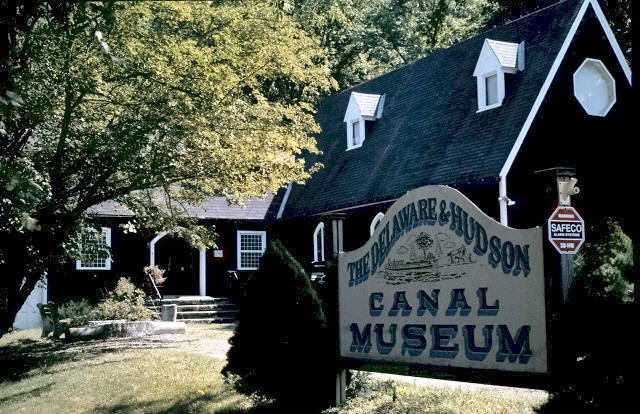
The Delaware & Hudson (D&H) Canal Historical Society and Museum of High Falls announced last December that the deal was sealed: the society now owned and would be relocating their museum to the 1797 Depuy Canal House.
”I’d been a trustee for around a year when we started putting this together, and I’d thought from the start that it could be done,” says society president Bill Merchant. “We put in three CFAs (consolidated funding applications) before we were finally approved; then, of course, the state doesn’t ever give you all the money for a project. You have to find somebody else out there who really cares.”
On the third try, the right combination of caring people got together. Jennifer Schwartz Berky, an architect and planner whose firm Home Strategic, LLC is active in a range of endeavors that blend historic preservation and sustainability, helped with the third grant application and brought the similarly-inclined Open Space Institute into the picture. In December 2014, the state Office of Parks, Recreation and Historic Preservation announced the $500,000 award that would make the dream attainable.
“Jennifer contacted (OSI vice president) Bob Anderberg and got the OSI on board,” says Merchant. “And John Novi, of course, bought the building and restored and protected it and started the society. Without any of those three people, we wouldn’t be where we are today - God love ‘em.”
It’s been 50 years since High Falls native Novi, then a 20-something chef, artist, and history buff, drew a crowd of 65 for the inaugural meeting of the Delaware and Hudson Canal Historical Society, Inc. Two years earlier, he’d purchased the 1797 DePuy Canal House, which he was then in the process of restoring.
The Society eventually established a small museum with a “nostalgic 19th century flavor” in a nearby former Episcopalian church, and Novi opened the Depuy Canal House, which became a destination restaurant after a four-star review from Craig Claiborne eight months after his 1969 opening. That was probably the first time many New York Times readers had given the hamlet of High Falls a thought -- at least since 1960, when Natalie Wood and Warren Beatty were in town filming Splendor In The Grass. (Before that, Marc Chagall painted there; soon after, Jan Sawka would take up residence; when High Fallonians say their hamlet is the Center of the Universe, they’re only half joking.)
It was the canal, though, that had powered the early development of the entire Rondout Valley–and helped shape New York City’s future.
A Treasured History
Before 1812, the United States relied on England for bituminous coal to supply its energy needs. It was too costly and burdensome to attempt to move it overland from the mountains where it was found to the urban centers where it was increasingly needed.
The War of 1812 meant no more British coal. Two Philadelphia drygoods merchants, William and Maurice Wurts, believed that the future of fossil fuel lay in anthracite coal, harder and cleaner burning and in ample supply in the mountains of Pennsylvania. The brothers purchased land and began mining, and soon realized that they needed to get their product to energy-hungry New York City.
The Erie Canal, opened in 1825, made history as the first way of moving large quantities of material between the Great Lakes region and the Hudson River. William and Maurice hired Benjamin Wright, an Erie Canal designer, to supervise surveying and construction. A year later, Wright turned leadership of the D&H project over to his Erie Canal subordinate John B. Jervis.
In three short years, with the efforts of 2,500 laborers using shovels, pickaxes and blasting powder, a marvel was constructed. Stretching 108 miles from Honesdale, Pennsylvania to Eddyville, where it met the Rondout Creek, the D&H Canal opened in 1828 and was soon carrying anthracite to the brick furnaces of Kingston and the blossoming industries of Manhattan. Goods were moved three miles an hour on barges as large as the canal’s 108 locks could accommodate. Four feet deep and 32 feet wide, the canal cost $2.2 million in 1828 dollars to build.
Towns sprung up where no towns had been before. Names like Port Jervis and Wurtsboro are two of the most obvious D&H connections; other traces are evident in the names of Towpath Road in Wawarsing and Creeklocks Road in Rosendale.
“They were hard nosed businessmen,” says Merchant of the Wurtses and their collaborators. “This was the first private million-dollar project in US history, and you can’t really overstate the impact it had on the region. The New York Times kept predicting failure for them, but that coal played a role in growing New York City into one of the world’s largest and most important.”
So did Rosendale cement, first discovered in 1825 and made portable when the canal opened. Small communities like Port Jackson, now known as Accord, had a steady influx of hungry and thirsty “canawlers” and a means of getting lumber and barrel staves to market.
High Falls, which began the 19th century as a fairly isolated agricultural spot, grew into a bustling center of industry and commerce, boosted in mid-century when that section of the canal was expanded and the Roebling aqueduct, a technological marvel of its day, was constructed. By the dawn of the 20th century, railroads had displaced canals. The DePuy House–which had prospered as a tavern and then served as canal office, store and lodging space after Simeon DePuy sold it to the D&H in 1835–became a tavern once again, eventually fated to fall into elegant disrepair and intrigue a local youth named John Novi.
Onward to the future
“I’m an antiquarian; my wife and I deal in antiques,” says Merchant, whose day job as a double bass luthier involves restoring antique instruments to their original condition. “We bought a house here that had been sited where it is because of the canal, and naturally we had to learn the history. What a story it is! Imagine High Falls as that bustling canal town. I love the D&H. It’s history right there in the ground. “
With such rich material at hand and already-developed assets such as the Five Locks Walk and the flourishing Sunday Market, the Canal Museum has already evolved into a tourism anchor; the move into the Canal House is the next logical step.
“Jennifer sees this as a potential tourism hub for Ulster County,” says Merchant, who has been delving into newly discovered source documents–the journals and letters of chief engineer Russell Farnum Lord, who oversaw the Five Locks Expansion in the mid-19th century, and an unpublished history he found on eBay–and presenting his discoveries at historic societies around the region. “It’s been lovely to see the surge in enthusiasm ever since we acquired the Canal House. It’s a challenging project; I have a great board, and they’ve rolled with it, and we have wonderful people involved like Peter Bienstock (an attorney and honorary Canal Society trustee) and Kim Elliman, the head of the OSI, who have helped make it happen.”
Turning the restaurant into a home for the museum will be a major endeavor; besides the $500,000 from the state, $350,000 in grants and $600,000 in bridge loans from the OSI, the society will be launching a capital campaign this fall to raise an additional $2 million for renovations, educational programming, creating endowment and reserve funds, and underwriting paid staff positions to supplement the work of the volunteers who’ve kept things rolling for the past five decades.
Themes the trustees would like to expand include farms and the canal, ruins, art and artifacts of the canal, regional tourism history, and the history of transportation ranging from Native American trails to the Thruway. By January of 2017, trustees expect to be able to present more detailed plans including timelines, renderings, budget and programming goals. Meanwhile, if you haven’t checked out the current museum’s offerings, there’s no time like the present.
“Right now, along with the artifacts, dioramas and documents, we have the Romeo Muller exhibit –the guy who wrote Rudolph the Red Nosed Reindeer and a lot of other stuff, just a typical lovable High Falls genius–and you can come catch the whole show for five bucks,” says Merchant. “During the Hudson River Ramble in September, we’ll have guided tours of the Five Locks Walk, and in October we’re hosting a wine tasting there with Stone Ridge Wine and Spirits and local food from Emmanuel’s.”
Much remains to be decided, and Merchant says the society welcomes community input as the journey continues.
“We are in the entertainment business,” he says. “We want to have a really strong program that’s compelling and fun, that makes people happy. Meanwhile, I won’t rest until we’re open in that building.”
For more information, visit canalmuseum.org.
by David DeWitt
Erin and I got new phones this week. Our old ones weren’t holding a charge for very long.
It still seems odd to me that something that is supposed to have superior technology has only a few years use. I bet the land-line phone I had as a kid would still work perfectly today if it were plugged in. I suppose texting with a rotary dial would be challenging though.
After we chose our phones in the store, Erin and I stood patiently listening to the sales associate try his damnedest to up-sell us with the latest cell phone add-ons, including a thin piece of plastic to protect the screen for a mere 35 dollars more. And of course, insurance.
“Just a few weeks ago a woman dropped her phone in the parking lot right after refusinginsurance,” he said. “It was very sad.”
“What you’re trying to do is very sad,” I thought to myself. But I understood. I use to work in retail too.
Finn was standing at my side and had gotten his hands on a demo virtual reality headset. We thought it was cute and snapped some pictures with our new phones. Then, he started walking around trying to grab at things in the ‘virtual world’.
“I want to get that little monkey!” he said, reaching his hand out and bumping into the counter. He pulled off the mask and looked around confused. “Where is it?” he said.
I took the headset from him and put it out of reach, to his dismay. I explained as best I could how it wasn’t real. I looked through it myself. It was pretty cool, but I could imagine how it seemed to him with his concept of reality.
I remember thinking at that age that people on TV were actually inside the television set. And after it had been turned off, I was convinced they were still there inside, having little parties.
How confusing today’s technology must be to smaller children about what is real, especially since animation is sometimes so hyper-realistic.
Standing there holding the virtual reality headset, looking down at his pouting face, I thought about how parents are kind of guardians of reality in early childhood. In a world where it’s hard for adults to figure out what’s real sometimes, that’s kind of a daunting task.
I thought about how much technology has changed in my lifetime and how different it will be when Finn is older. How one day he will have a phone, but hopefully won’t spend too much time staring at the screen.
When I turned back to the salesman, he was telling Erin about a gadget we just HAD to have for
the car that would record regular engine diagnostics and all sorts of other things. Then he toldus about special watches he bought for his kids to wear so he could track them at all times. Hmmm.
I think next time we’ll just buy the phones online.
David Dewitt is an artist, blogger, and painter who lives with his family in the Rondout Valley. For more, visit daviddewitt.com.
by Lee Reich
Black currant fruits are “of a stinking and somewhat loathing savour, the leaves also are not without the stinking smell,” wrote herbalist John Gerard in his famous Herball over 350 years ago. I disagree. I relish this fruit. And as far as the smell–no, the aroma–of the leaves: I think it makes pruning black currant bushes or even brushing up against them a heavenly experience.
Odd that Mr. Gerard should write so venomously against the plant. Of many people that have smelled black currant leaves in my garden, no one has given the rich, resinous aroma anything but praise. The leaves even have been and are used to make a tea, both for their flavor and medicinal properties. The fruit was just coming into cultivation in Gerard’s time, and in the 350 years since publication of the Herball, Europeans have grown exceedingly fond of the fruit. Usually, the fruits are cooked up into a delectable jam or squeezed to make a rich-tasting juice (Ribena is a well-known British brand). In the Bordeaux region of France, black currant fruits are made into the liqueur cassis.
It’s not only for the taste that northern Europeans (and I) enjoy black currants. The fruit is extremely high in vitamin C, and even before vitamins were known, the fruits were called “quinsy berries” for their soothing effect on sore throats.
So how come hardly anyone here in the U.S. grows black currants? The reason traces back to the end of the 19th century, when a disease called white pine blister rust hitchhiked into this country on some pine trees from Ireland. The fungus that causes white pine blister rust needs two different host plants–a white pine and a susceptible Ribes, a genus that includes gooseberries and currants–to survive. To keep this disease from threatening the valuable white pine timber crop, the federal government decided to ban the planting of Ribes.
The ban’s effectiveness was limited, though, because of the many wild Ribes in our woods, and the great distances that disease spores could travel. And anyway, most cultivated gooseberries and currants are resistant to the disease. So the federal ban was lifted in 1966 and put under state mandate. Nonetheless, while the federal ban was in place, two generations of Americans forgot about how good gooseberries and currants tasted.
Black currant is the most susceptible of all cultivated Ribes to white pine blister rust. But thanks to Canadian fruit breeders in the 1960s, a few rust-immune varieties–Consort, Crusader, and Coronet–were developed. Since then, a number of better-tasting rust-immune or rust-resistant varieties have been identified, varieties such as Titania, Belaruskaja, and Kirovchanka.
In addition to good fruit and pleasant aroma, black currants have other qualities to recommend their planting. Deer evidently concur with Mr. Gerard about the aroma, because they rarely nibble the plants. Mice agree: In a winter, when they girdled many plants beneath the snow line, only my black currant plants were left consistently untouched. Insects, diseases, even birds, similarly keep their distance.
The only care the plants need is pruning. One year old stems bear best, so all that’s needed is to each winter cut to the ground stems that are going into their second year.
Black currant is a quietly handsome bush. No visually notable flowers adorn the stems nor do the leaves light up with fall color at the other end of the season. But all season long, beginning early in spring and continuing well into fall, the bush is attractively clothed in lush, forest-green leaves. As an edible specimen shrub, give black currant six feet of elbow room all around; as an edible hedge, set black currant plants three feet apart. No need to choose a site in full sun, as required by most other fruits, because black currant will grow and fruit well in sun or part shade.
There is only one thing that you should not expect from a black currant bush, and that is “black currants” such as are sold dried in boxes in the markets. Those are dried ‘Black Corinth’ grapes, a small grape dried and shipped for centuries from a Greek port of that name. Those raisins came to be called bastarde corinthes and corans on their way to being called “currants.”
Black currants are so delectable and easy to grow that they warranted a whole chapter in my book Uncommon Fruits for Every Garden, available, among other places, at leereich.com/books/uncommon-fruits-for-every-garden.
Lee Reich, PhD (leereich.com) is a garden and orchard consultant; he hosts workshops at his New Paltz farmden, which is a test site for innovative techniques in soil care, pruning, and growing fruits and vegetables.
Back in the ‘70s, visitors to the Shawangunks simply drove onto the shoulder, cut the engine, and scooted into the woods to hike, picnic, or splash in the creek. Idyllic as it may sound (and from a teenage perspective, it was indeed idyllic) such a laissez-faire policy was in no way sustainable for such a fragile ecosystem, especially located a scant hour and a half from a metropolitan area inhabited by over 20 million souls.
When the state took over Minnewaska in 1987, random roadside parking came to a screeching halt. Locals understood this as the lesser evil; had a Marriott Hotel been built there, it seemed likely that that section of the Gunks would have been lost to public use forever. Since 1993, when the state opened Minnewaska State Park Preserve to the public, visitors have steadily increased in 2007, there were an estimated 250,000 guests, and by now, the number is much closer to 300,000. According to a study in 2010, Minnewaska, Sam’s Point (which has since become part of the park, and is, as of this writing, closed until further notice due to fire) and Mohonk Preserve visitors contributed $12.3 million to the local economy and sustained 350 jobs. That was before National Geographic named the Hudson Valley as a Top 20 destination.
Anyone driving Rt. 44/55 on a summer weekend can testify to the fact that the park has a parking problem. State officials have taken notice, and last October Governor Andrew Cuomo announced a $7.3 million plan to modernize the gateway to the park and better accommodate the growing number of visitors. Plans include a new 6,000-square-foot visitor center with exhibit and classroom space, public bathrooms and park offices, and a warming hut that accommodates up to 50 visitors, great news for the cross-country ski set.The plan, and the money, are a public/private partnership endeavor between the state and land conservation non-profit Open Space Institute.
The first phase of the multi-year project is the reconstruction of the Route 44/55 entrance to create stacking capacity for vehicles waiting to enter the Preserve and add automated parking fee payment options, relieving traffic congestion on peak visitation days. Park manager Eric Humphrey says it’s not a moment too soon. “The main entrance redesign should alleviate traffic congestion. Currently we can only accommodate six to eight cars ‘on hold,’ once we have this done we can stack up 45. We’re also in the beginning stages of parking reconfiguration. We’ll be able to handle about 350 cars, which is consistent with what we have right now, but the lot will be paved and lined and much more organized. People will be able to self-park, rather than having multiple staff out there directing traffic. We’ve been making do with the gravel lot we inherited from the site’s time as a small private hotel, and we’ve been making it work, but this will create a much better experience for everyone involved.”
There are no plans to add more parking. “Capacity is capped to stay within the carrying capacity of the land to protect the resources. The whole project, in every phase, is designed to that end– to give people a great experience, but also to make it one that will be shared by future generations.”
Humphrey says massive credit is due to the Open Space Institute, which has committed $3 million to the capital project. “We have doubled the size of the preserve over the past forty years with our various acquisitions, and hopefully that adds some breathing room,” says Eileen Larrabee, OSI’s communications director. “There is always a balance in trying to maintain what is special and allow the public to appreciate it. When you think about Minnewaska and how it was formed, people arrive at the entrance point without much guidance about what to see and how to plan for it. The visitor’s center will help with that, and so will reclaiming the carriage roads, which open up a lot more options for visitors to enjoy.” The OSI has restored 22 miles of the 35-mile carriage road network, and is restoring two more roads this summer..
Skills for the Cats
To the northwest, the Catskill Forest Preserve is made up of 287,500 acres of state-owned wild lands within the Catskill Park, which stretches over parts of Ulster, Greene, Sullivan and Delaware counties. Yet even with that much space, careful management is required to ensure that visitors have the best possible time while inflicting the least possible damage.
Happily for the Catskills and their company, the Maurice D. Hinchey Interpretive Center– opened in Mt. Tremper in 2015 under the management of the nonprofit Catskill Center. The Center has been advocating for the protection and stewardship of the 700,000 acre park since 1969, striving to balance the needs of towns and private landowners with the operation of the New York City Department of Environmental Protection, the New York State Department of Environmental Conservation, many thousands of visitors out to recreate, and the habitats themselves.
Michael Drillinger, project coordinator for the Hinchey Center, says that having a visitor’s center –as the privately held Mohonk Preserve has had since 1998, and as the state park expects to break ground on sometime between now and 2018–is a huge asset in managing guest flow. “We’re very conscious of all the choke points,” he says. “For example, the parkings area for spots like Giants Ledge and Blue Hole, the spots that have gotten into the New York metropolitan media. We try to direct people to alternate places. It results in a lot less frustration. For example, the parking areas for Panther Mountain, Giants’ Ledge and Slide Mountain are typically packed on a weekend. But what most people don’t realize is that just a mile farther down the road, we have the Biscuit Brook parking area, and there’s an easy two mile walk to a really nice spot from there. And there are a lot of places that haven’t made it into the mainstream press that we can direct you to. Last summer it was a huge issue that too many people wanted to swim at Blue Hole. What they didn’t realize was that right in the same area they could go to Kanape Brook. Part of our purpose here at the Interpretive Center is giving suggestions of lovely places people can go that are less utilized.”
Littering in well-publicized spots has been a subject of concern lately, but Drillinger says he is optimistic that patience, persistence and education will improve matters. “I think that situation was captured beautifully by a DEC fellow at a recent meeting,” he says. “He approached some visitors about their garbage, and they said, ‘You don’t have cleanup staff?’ They were accustomed to the fact that in city parks, staff are paid to pick up trash. When the officer explained to them about carry in, carry out, they got it and abided by it. They weren’t being dirty on purpose; it was the context they were coming from. The DEC did a poor job managing the Blue Hole situation at the beginning of the summer, but by the end of the summer, it got noticeably much better. They had a dumpster, the right kind of signage.”
Getting Centered
The interpretive center was built and is owned by the state, while the Catskill Center operates it and raises funds. “We’ve created something called the Catskill Coalition to lobby Albany for funding for the park, and established the Catskill Park Advisory Committee with the New York/New Jersey Trail Conference so we can advise the DEC and the DEP about how to spend the monies that get raised,” says Drillinger. “The DEC is learning to adjust to the influx. We want more people to come and play, visit, eat and shop.To make it a great experience we have to improve, with things like parking, signage, and composting toilets at trailheads. All of that is in the works.”
Besides directing traffic, interpretive centers educate visitors about the importance and preservation of the places they are about to enjoy. The CIC hosts geology lectures, economic development forums and climate change seminars. The Mohonk Preserve’s center offers indoor exhibits and short, self-guided interpretive trails to help guests get acclimated. The planned visitor center at Minnewaska will include exhibit space and classroom space for environmental education programs, as well as public bathrooms and park offices. The center will also bring potable drinking water to the park for the first time.
It’s something of a delicate dance but, as Drillinger says of the DEC, all involved are getting better at it. And everyone’s eyes are on the prize: preserving our wild lands while enhancing the delight and ease of visiting and playing in them.
“We want people to have a wonderful experience and bring their children, and those children will grow up to appreciate the land and become stewards in their own right,” says Larrabee. “It’s the only way to build the next generation of people who will carry this work forward.”